
Joe Batt’s ‘Connectivity’ connects us all
By Madyson Muresan
Co-Arts & Culture Editor
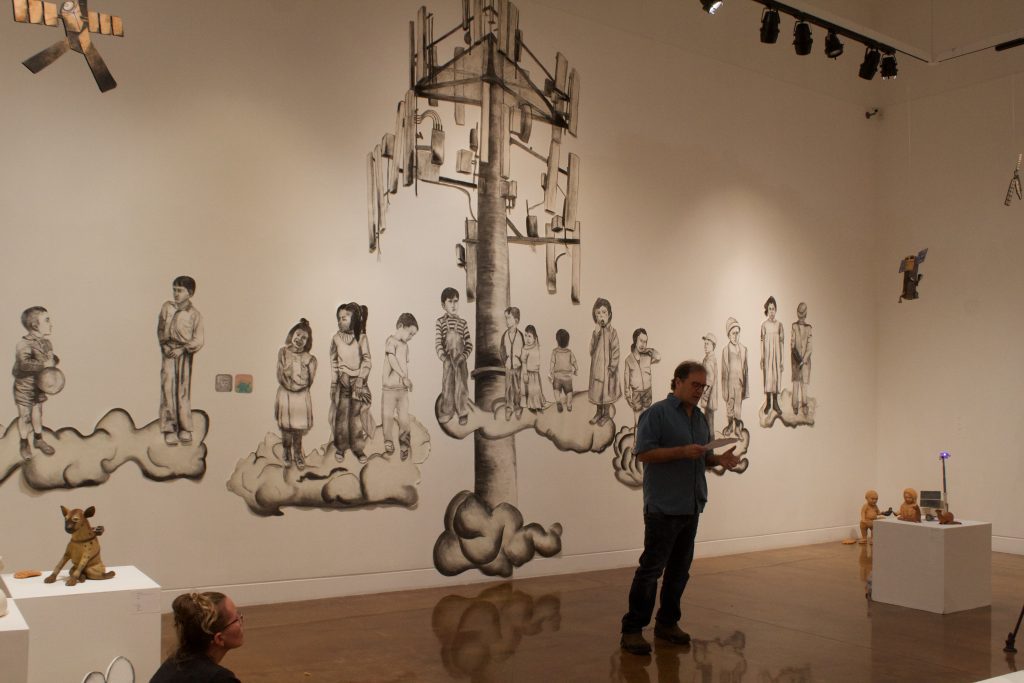
Joe Batt speaks during his artist’s reception with his pieces “Cell Tower”, “Line of Seekers” and “Apps.” Photos by Madyson Muresan
In the age of modern technology where much of human interaction happens through a screen, Joe Batt challenges the viewer to think critically about our ever growing digital consumption and what it means to connect with others through it. Batt’s exhibit “Connectivity” delves deeper into those topics.
The Alexander Gallery opened its doors to Batt’s “Connectivity” last week and held an artist’s reception on Nov. 18. There, he spoke about his interest in our relationship with technology and how it has changed our relationship with each other.
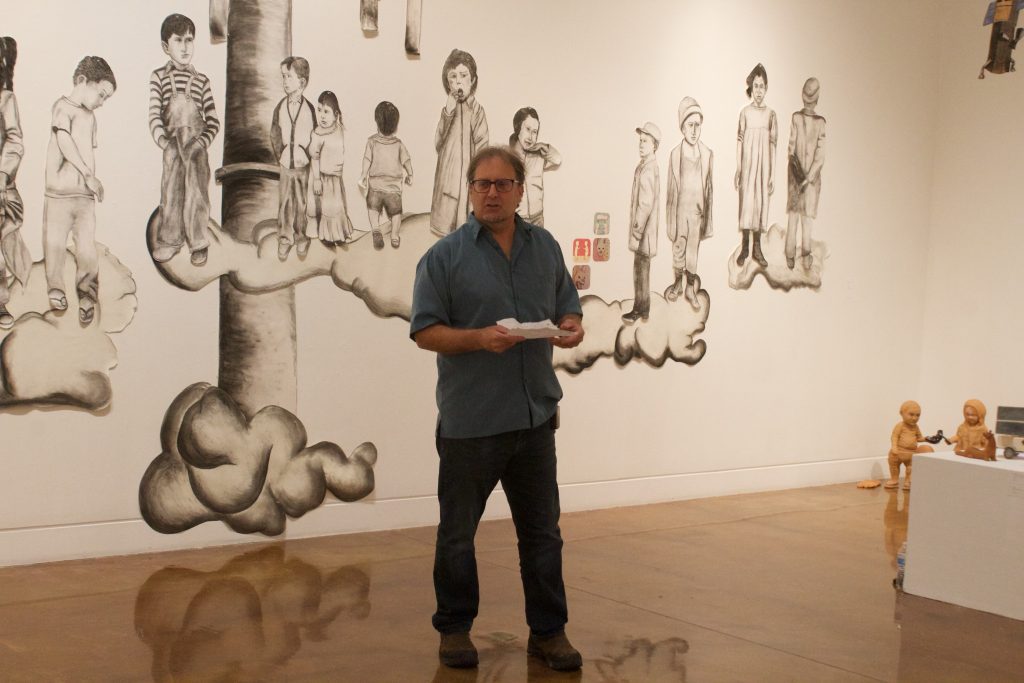
Joe Batt speaks about his exhibit during the artist’s reception.
“My main concern is about humans and people, not so much about technology. Technology really is more of a vehicle that people use for different things,” Batt said during the opening of his address as he spoke about the broader theme of his exhibit.
“I think we have a responsibility to be thoughtful about how we engage with each other with these tools. Which are turning into something a lot more than tools right now and it’s worth having a conversation that continues to go on as we move forward.”
Batt’s exhibit consists mainly of children and animals interacting with pieces of technology, such as iPads or gaming controllers. “I often sculpt children. My experiences, in other projects as well, are told through the eyes of children,” Batt said.
Batt grew up in northeastern South Dakota. He spoke about the glacial hills and open countryside of his childhood home and how that shaped his art today.
“…I grew up hunting. I grew up running free. I’m the 10th of 12 children. My relationship with nature through my childhood experiences have been a big part of my artwork.”
Batt’s earlier pieces in his exhibit are “Conversation” and “Roamer with iPhone” which both show children interacting with modern day technology.
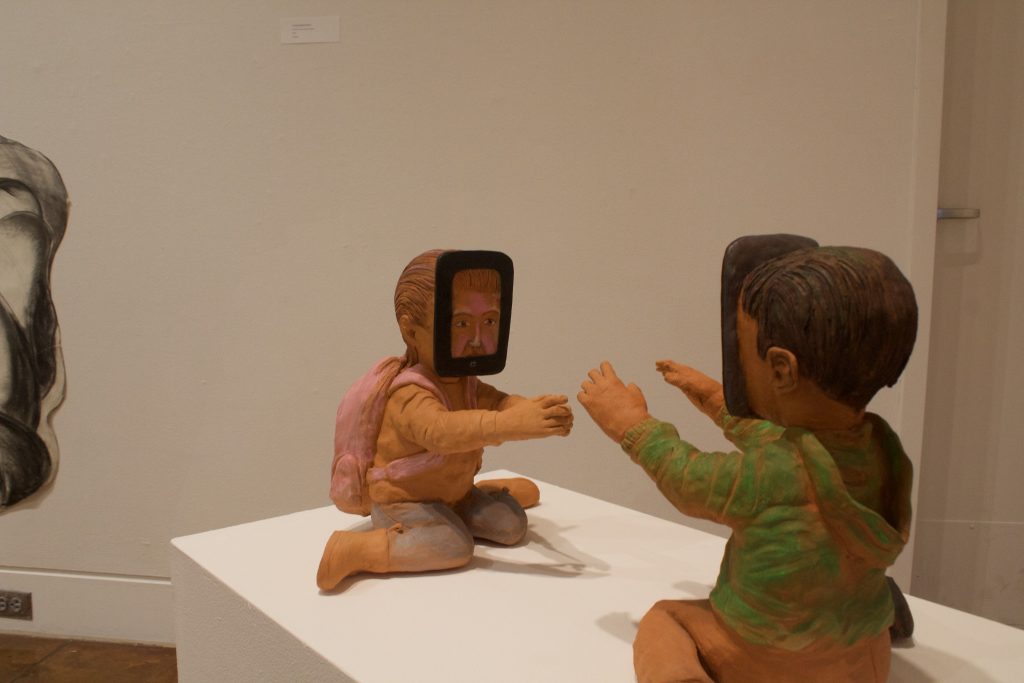
Batt’s sculpture “Conversation.”
“Conversation” features two toddlers sitting across from each other with iPads on their faces. Their arms are stretched out, reaching for each other. Through the iPads, you are able to see their emotionless faces. The sculptures are painted with bright colors such as neon green and light pink.
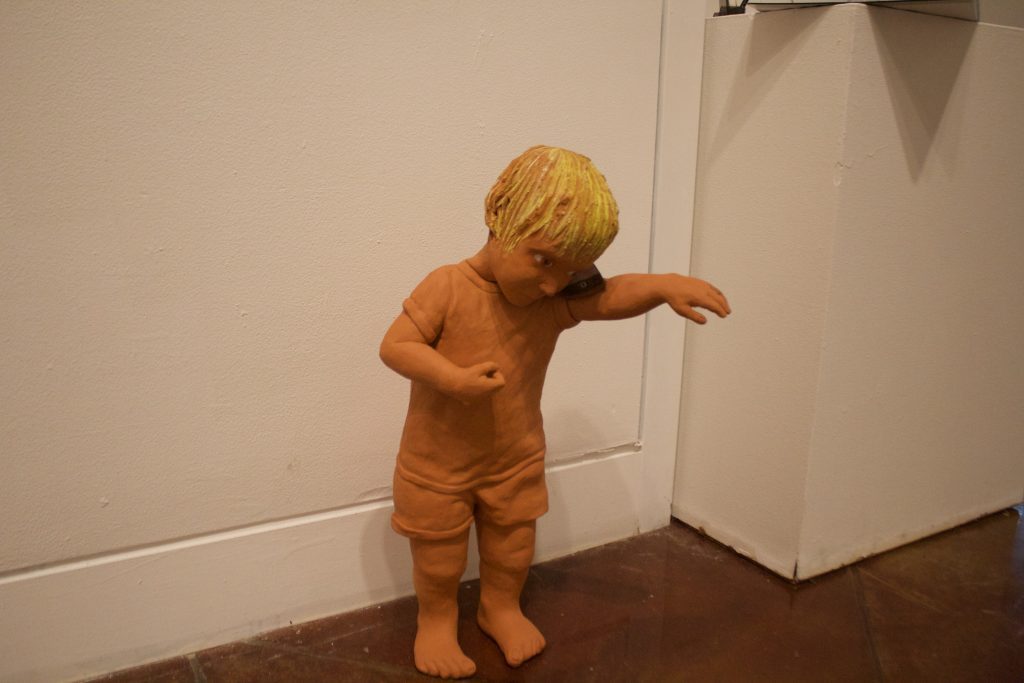
Batt’s sculpture “Roamer with iPhone.”
“Roamer with iPhone” is a standing sculpture of a little girl with a cellphone pressed to her ear. This sculpture was modeled after a photograph of Batt’s granddaughter playing with her mother’s phone. The child’s arm is stretched out in order to hold her shoulder high enough to press the phone to her ear. Her face is turned downward and left emotionless as she stares at the floor.
“I also got started on this project thinking about cave drawings. I’m thinking about the endurance of art and culture,” Batt said, “At the same time as I talk about these issues, I wonder sometimes if a digital file will last 40,000 years like a cave drawing or if it will not. What will last?”
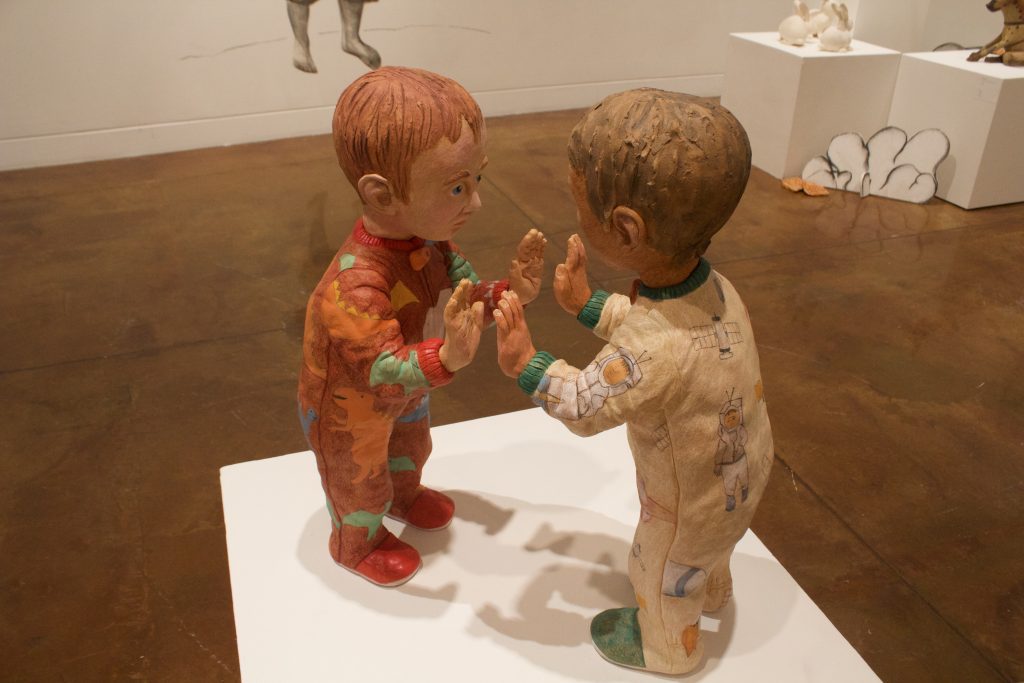
Batt’s sculpture “Connectivity.”
The name “Connectivity” comes from a later sculpture added to the collection featuring two children wearing union suit pajamas. One child’s pajamas has dinosaurs on it and the other has planets and astronauts. The children stand close with their hands outstretched, nearly touching. Unlike all other sculptures, this piece has no technology interfering with their interaction. The only piece of technology featured are satellites on the child’s pajamas.
Batt explained during his reception about the piece and what it represents to him.
“For me, [people] are fascinated with how technology can help us move out into the universe, but we also have this fossil history of hundreds of millions of years and how do those two things work together? What’s gonna be here 100 million years from now?”
As Batt spoke, he offered many thought-provoking questions to the audience. His exhibit delved deeper into our understanding of technology, how we use it and how it could be using us in return.
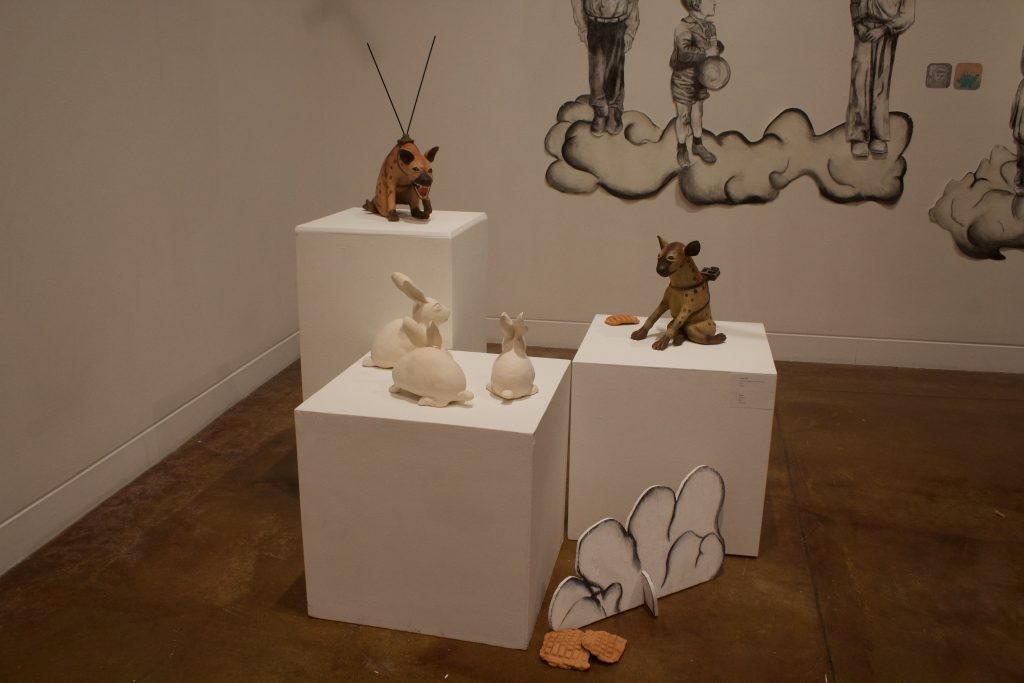
Batt’s sculptures “Preying Hyenas” and “Bunnies.”
His piece showcasing hyenas and bunnies help to show Batt’s view on how technology can be used in a predatory manner. In his sculpture we act as the innocent bunnies being preyed on by the growling hyenas with pieces of technology attached to them. It symbolizes the predators preying on unknown victims through the internet and how defenseless we are against those predators.
He mixed pieces of history and culture into his art which give a glimpse into our past while investigating our present. He also toyed with technology of the future with a drawing of a child wearing futuristic glasses.
“My perspective is through my eyes and looking at the digital paradigm through the eyes of children. Being a parent myself it’s been an issue being around kids and seeing them using technology and being left to wonder about the impacts of that.”
The gallery is open Monday through Friday from 9 a.m. to 5 p.m. and ends on Dec. 5. The exhibit is free to attend.
