
College president reflects on 1,400-mile run
By Corban Stanton
Copy Editor
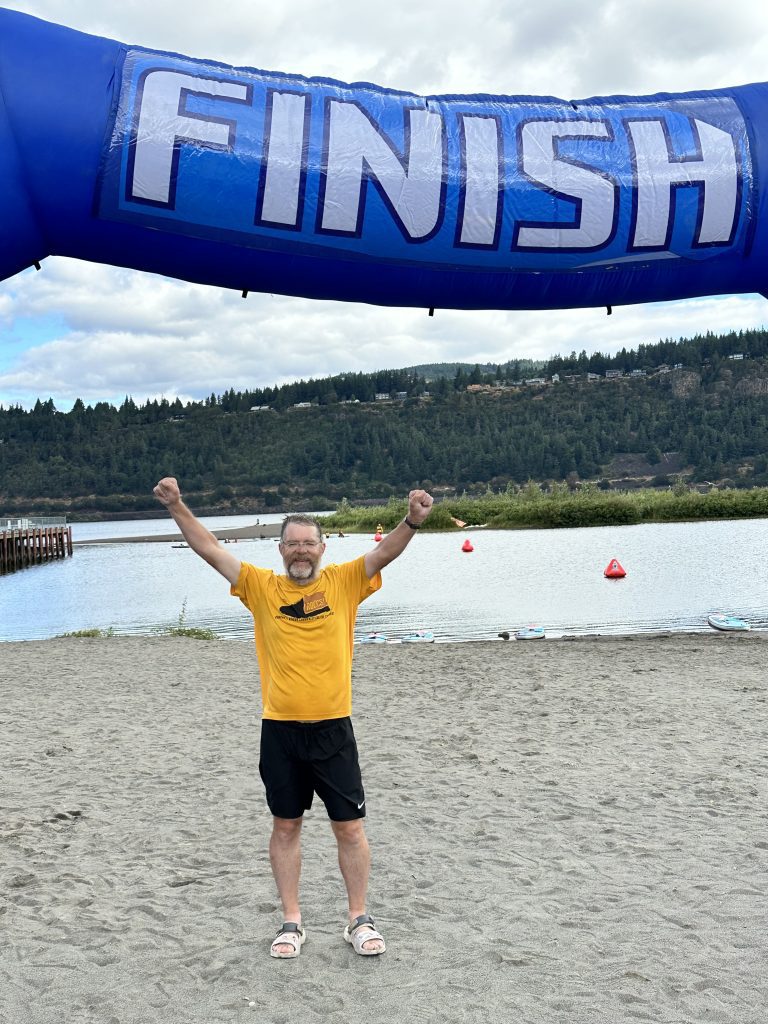
Tim Cook at the finish line in Hood River. Photo by Paddy Cook
Life after running 1,400 miles in 53 days isn’t the same as before; daily routines such as having a personal bathroom, consistent cell service and control of the temperature become novelties.
President Tim Cook of Clackamas Community College finished his charity and awareness run on Aug. 7. Since then, he has been recovering and getting back to his executive job.
Cook ran 1,411 miles on his journey, averaging 27 miles a day. He climbed 64,183 feet, which is more than summiting Mt. Everest two times over. On the gnarly side of things, he lost five toenails and obtained more blisters than was worth keeping track of.
When asked what statistic he thinks surprises people most, Cook said, “You know, a lot of people do their 10,000 steps a day and so I wasn’t really paying attention to steps, but I figured people would want to know what it translated to. So almost four million steps, I think blew people away.”
However, the run was more than just the stats.
“Physically the hardest part was the heat and the elevation in Southern Oregon. That combination was really challenging,” said Cook. “But what I have kind of come to, reflecting on this, is mentally, it was harder getting up knowing everyday I had to go run another marathon that day.”
For Paddy Cook, Tim’s wife, the challenges were different. Instead of pushing through pain herself, she was minimizing her husband’s and giving him the freedom to run.
Paddy faced the stress of not always having contact with her husband, saying “You know, we covered a lot of ground in the state, and it’s very different, the areas. Southern Oregon is very different from the coastal range, and there were a lot of parts along the route where we didn’t have cell service. We didn’t always have a person that had eyes on Tim.”
Life on the road wasn’t easy, but Paddy said she regrets nothing.
“I had a lot of friends or other wives say to me ‘Oh my gosh, I would never do that’ or do what I did,” Paddy said. “And I just can’t imagine not supporting my husband and being with him. No. 1, I am his biggest cheerleader. But No. 2, for him to be out on the road like that and to not know what’s happening and where he is at and how he is doing would just drive me crazy.”
Settling into a routine came pretty quickly for Cook. Even though they were staying at friends’ houses, Cook usually started winding down around 7 p.m. and tried to be in bed by 8 p.m.
Ultimately, it worked well. “I probably had the best sleep I have had in years,” said Cook. “I was so tired at the end of every day. If I was up past eight I was drooping. I think it was one of the things that saved me as far as recovery. I was getting a good eight or nine hours of sleep everyday.”
It’s not surprising that after averaging more than a marathon a day, he was tired.
Parts of the run pushed Cook to the limit, but there were other times that it was nice to be out mindfully exploring Oregon, he said.
“I really just miss seeing parts of the state and being out running. I mean, I wouldn’t do it again, but it’s one of those things that I will never get to do quite again.”
Paddy can list off names of new friends they made, crew members and running partners. It was a team effort to finish the run.
Some of Cook’s favorite moments came from meeting old friends that had been tracking him, or coming around a corner and seeing a herd of elk.
The adventure and the people were an addition to this trip though, the real point was the students. When Cook initially set off it was because he recognized that the students of community colleges are struggling.
Many on a daily basis have to choose between whether they eat or pay rent.
“I will be honest with you, it was for the students,” said Paddy. “Because Tim and I talked about this a lot even before we started, that we have seen our community college students struggle and they have to make decisions that were way harder than what we did in our day.”
Originally the monetary goal was to raise $150,000, but Cook said it was always more about raising awareness.
“I am pretty satisfied. I am really happy with my main goal, the awareness goal. I exceeded that in my mind, all the news and legislative support and all the rest: That was far more than I thought. I think why I am satisfied with the fundraising goal, at least for Clackamas, is we will use the money to set up an endowment so it will always be there.”
“Now I am in this sort of part where I am giving presentations and still continuing to talk to people about this. I think that the legislative work to continue to work statewide will be part of it.” said Cook.
Running For Oregon’s Community Colleges, or ROCCS, is over but the awareness campaign isn’t.
